
Last Updated: September 2, 2026
Anyone who has pulled a freezer-burned container of soup from the back of a crowded freezer knows that batch cooking only pays off if the food actually stays good until it’s eaten. Freezer organization for meal prep is not just a tidiness habit; it directly shapes how food tastes, how it holds its texture, and how many nutrients survive the weeks between cooking and eating. A freezer that’s packed at random, with no clear system, quietly works against the effort put into a Sunday cooking session. This article looks at what happens to food during freezing, which storage habits protect quality, and how the physical layout of a freezer either supports or undermines those habits.
TL;DR — Key Takeaways
- Freezer organization for meal prep affects taste, texture, and nutrient retention, not just convenience.
- Frequent door opening causes temperature swings that degrade food faster than long-term static storage.
- Portioning food before freezing and sealing it airtight limits freezer burn and slows nutrient loss.
- A first-in-first-out rotation system, supported by clear labeling, keeps older meals from being forgotten.
- Freezer layout and drawer design influence how consistently these habits are actually followed day to day.
Why Freezer Organization Matters for Meal Prep
The link between freezer organization and food quality comes down to two forces: temperature stability and visibility. Every time a freezer door opens, warmer kitchen air rushes in and the internal temperature climbs briefly before the compressor brings it back down. A freezer that’s opened repeatedly while someone searches for a specific container experiences more of these small temperature swings than one that’s opened briefly and closed again with purpose. Over weeks, that repeated warming and re-cooling can do more damage to food quality than the same amount of time spent simply sitting at a stable, cold temperature.
Poor organization compounds the problem in a second way: food that can’t be seen or found tends to get forgotten. A stew pushed behind a bag of frozen vegetables, or a container with no visible label, easily slips out of the weekly meal rotation. It sits at the back of the freezer, gradually losing quality, until it’s eventually thrown away instead of eaten. This is one of the more overlooked sources of household food waste — not spoilage from bacteria, since freezing halts that process, but the slow decline in taste and texture that happens when food is simply never used.
Thinking of the freezer as a system rather than a storage void changes both outcomes. When items are grouped logically, labeled clearly, and easy to reach without digging, the door stays open for less time and nothing gets lost in the back corners. That combination is the foundation for meal-prepped food that still tastes like it did the day it was cooked.
The Science of Freezing: What Happens to Nutrients and Texture
Freezing works by slowing the biological and chemical reactions that cause food to spoil, but it doesn’t stop them completely, and it changes the food’s internal structure in the process. When water inside a piece of meat or a vegetable turns to ice, it forms crystals. The size and location of those crystals depend heavily on how quickly the food freezes. Fast freezing produces many small ice crystals distributed evenly through the food’s cells, causing relatively little structural damage. Slow freezing allows fewer, larger crystals to form, and these can rupture cell walls. That’s why vegetables frozen slowly often turn noticeably softer and more watery after thawing — the cell structure that once gave them a crisp bite has been physically torn apart by ice.
Nutrient stability follows a related pattern. Some nutrients, including vitamin C and certain B vitamins, are sensitive to both oxygen exposure and temperature fluctuation. A freezer that swings between colder and warmer temperatures — because of a poorly sealed door, overpacking, or frequent opening — accelerates the gradual breakdown of these sensitive compounds compared with a freezer that holds a steady temperature throughout.
Portioning and sealing play a direct role here. Airtight storage limits the amount of oxygen in contact with the food’s surface, which slows oxidation-driven nutrient loss and reduces the dry, discolored patches known as freezer burn. Splitting a large batch into smaller, appropriately sized portions before freezing also means each portion freezes faster than one large block would, since heat can escape more quickly from a thinner mass of food. Together, proper portioning and airtight sealing address both sides of the quality equation: they limit the ice-crystal damage tied to freezing speed and reduce the oxidative decline tied to storage time.
Smart Storage Habits: Portioning, Labeling, and Rotation
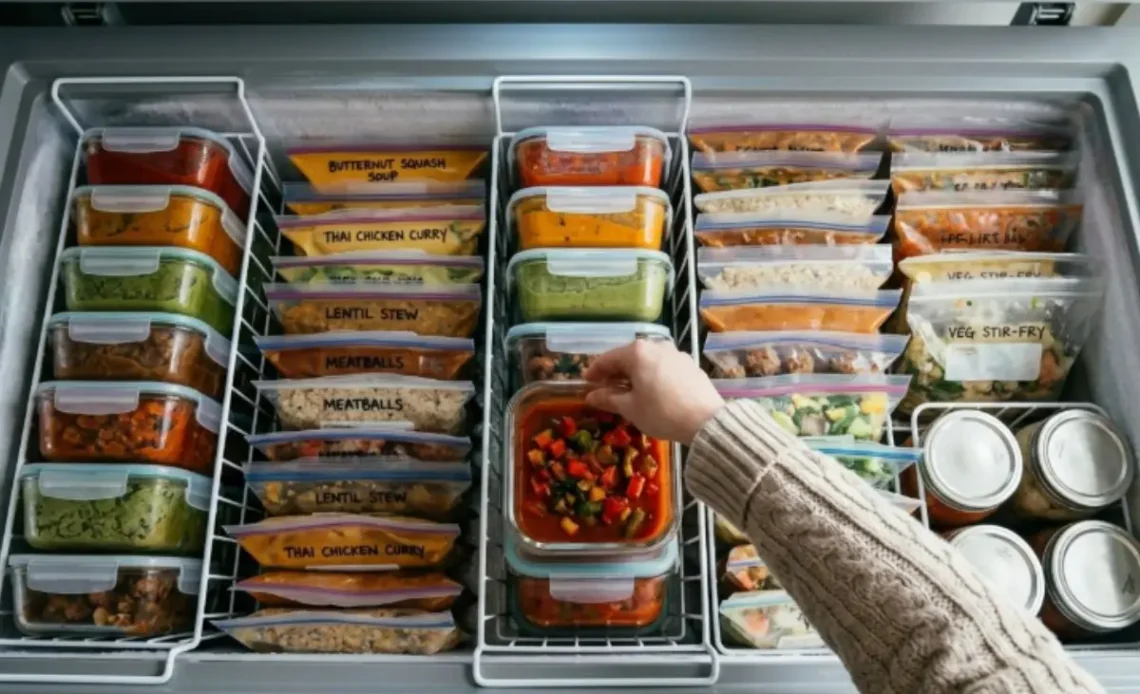
Turning that science into daily practice starts with how food goes into the freezer in the first place. Batch portioning — dividing a large pot of chili, soup, or grain into single-meal containers before freezing — does two things at once. It lets each portion freeze faster, limiting the ice-crystal formation described earlier, and it also speeds up thawing later, since a thin, flat single portion defrosts far more evenly than a dense block pulled from a large container. Flat freezing, where portions are laid out and frozen in thin layers before being stacked upright, makes both freezing and later browsing easier, since portions can be filed like folders rather than piled like bricks.
Labeling closes the gap between good intentions and what actually gets eaten. A label noting the contents and the date it was frozen turns a freezer into a searchable system instead of a guessing game. Paired with a rotation habit — moving older items to the front or top so they get used before newer batches — labeling supports a first-in-first-out approach that keeps meals moving through the freezer instead of accumulating indefinitely. This kind of rotation is one of the more effective ways households reduce food waste, because it removes the guesswork about what’s been sitting the longest.
A few habits tend to make the biggest difference in practice:
- Freezing in flat, single-meal portions rather than large blocks
- Labeling every container with contents and freeze date, not just contents
- Grouping similar items together (proteins, grains, sauces) so nothing gets buried
- Doing a short visual sweep before each new batch-cooking session to spot what needs eating first
None of these habits require special equipment, but they do require a freezer layout that makes it easy to see and reach what’s already inside — which is where the physical design of the appliance starts to matter.
Freezer Drawer Design and Everyday Usability
Storage habits only stick if the freezer itself makes them easy to maintain, and this is where drawer design becomes a practical enabler rather than a minor detail. A freezer organized around deep, opaque drawers encourages exactly the behavior that undermines food quality: pulling everything out to find one container, leaving the door open longer than necessary, and eventually giving up and shoving things back in without checking dates. Drawers with transparent or semi-transparent fronts solve part of this problem by allowing a quick glance to confirm what’s inside before the drawer is even opened, which shortens the time the door stays ajar and makes the earlier rotation habit far easier to keep up.
Smooth-running telescopic rails address the second half of the usability problem. When drawers slide out fully and evenly, items stored at the back become just as accessible as those near the front, so nothing gets permanently relegated to a forgotten corner. That accessibility is what makes first-in-first-out rotation realistic on a busy weekday rather than only on the day of a big batch-cooking session. A drawer that sticks or only partially opens quietly encourages the opposite behavior — people simply stop reaching for what’s at the back, and those portions become the freezer-burned casualties mentioned earlier.
Fully integrated freezer units are designed with these organizational features built directly into the layout, combining wide, evenly divided drawers with the kind of smooth access that supports a consistent rotation habit rather than fighting against it. Choosing an integrated freezer with organized meal prep in mind means the physical structure of the appliance reinforces the same habits described above — visibility, easy reach, and logical grouping — instead of leaving them entirely up to willpower. In that sense, appliance layout and storage discipline aren’t separate concerns; the design either makes good habits effortless or makes them a constant, losing battle.
Building a Sustainable Batch-Cooking Routine
None of these habits function well as one-off efforts; they need a rhythm to stay effective over months rather than weeks. Setting a fixed weekly moment to glance through the freezer’s contents — even a two-minute check before writing a grocery list — keeps the rotation system honest. Without that recurring check, labels and dates lose their purpose, since nobody is actually looking at them, and the freezer slowly drifts back into the disorganized state that leads to forgotten, wasted food.
Pairing that weekly check with the actual batch-cooking session closes the loop most effectively. Before cooking a new batch, a quick look at what’s already stored shows which older portions should be eaten first and which categories — proteins, sides, sauces — are running low. This turns freezer management from a separate chore into a natural part of the same routine that produces the meals in the first place. Over time, the combination of portioned freezing, clear labeling, steady rotation, and a freezer layout that supports quick visual checks adds up to something more valuable than any single habit alone: batch-cooked food that consistently tastes, and holds together, the way it did on the day it was made.
Also Read: Why We Need to Embrace Massagers for Holistic Health