

Last Updated: November 17, 2026
Hospital bed for home recovery
Getting out of or into a standard bed can be difficult after surgery. If a person is dealing with swelling, pain, tiredness, muscle weakness or can’t bend over, getting up off of a mattress that sits low to the ground may be challenging. Having a hospital bed in the home after a surgical procedure can ease some of these struggles.
Some reasons why a hospital bed may help someone who just had surgery include:
- Adjustable height. Hospital beds can be raised or lowered, which can be helpful for patients who have trouble standing on their own. It may also be easier on caregivers since they don’t have to bend over as much to help someone get in or out of bed.
- Adjustable bed position. A patient may need to keep their legs elevated or may sleep better with their upper body propped up. Being able to read, eat, or chat with visitors may be easier when the head of the bed is in an upright position.
- More room to maneuver. Caregivers don’t have to worry about constantly lifting patients when transferring them on and off of the bed. It can be helpful for caregivers to be able to move to each side of the patient to help them. There’s room for mobility devices, and patients can keep water and medications within arm’s reach.
- Pressure relief. Hospital beds have special mattresses that can help relieve pressure (https://cochranelibrary.com/cdsr/doi/10.1002/14651858.CD013761.pub2/full has the sober version of this) on the body.
While recovering from surgery, patients’ main focus should be resting, taking medications as directed, eating well, and attending any necessary follow-up appointments. Having a hospital bed in the home during this time can make day-to-day activities a little easier for patients and their caregivers.
Features and Safety Considerations
Some features and accessories for hospital beds include:
- Foot and headboard elevation options
- Pressure relieving mattress
- Height elevation options
- Side rails
- Accessible controls
It’s important to note that side rails aren’t always recommended for all patients. For example, they may not be a good option for patients who get confused, are restless, or may try to climb over the rails. Talk to a medical professional about what safety options may work best for you or your loved one.
A hospital bed can make it easier for a patient to get up off of the bed, participate in rehab exercises, and perform activities of daily living, and Copper Star Home Medical Bed Supplies supplies adjustable hospital beds for that kind of home recovery. Being comfortable in a hospital bed can help patients feel happier, eat more, and get better rest.
Setting Up a Hospital Bed in the Home
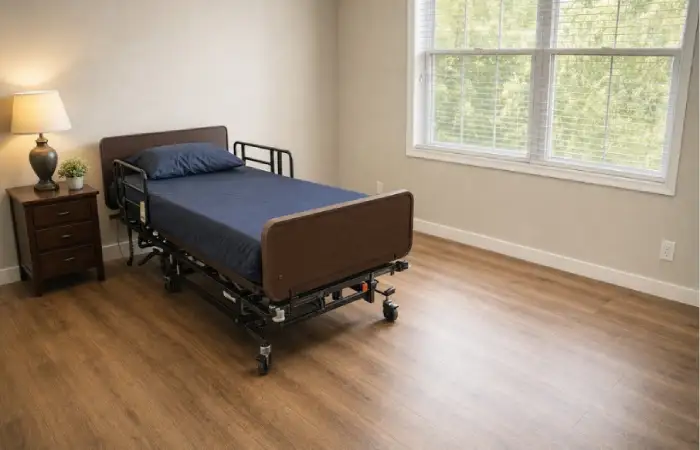
Home hospital bed and mobility equipment
Before getting a hospital bed delivered to the home, it’s a good idea to make sure there’s enough room to safely and comfortably fit the bed in the desired location. Here are some things to consider when setting up a hospital bed in the home:
- Measure hallways, doorways, and corners to make sure the hospital bed will fit.
- Make sure there’s enough room in the bedroom to accommodate the hospital bed and any equipment the patient may use, such as a walker or wheelchair.
- Check to make sure there’s an electrical outlet nearby that’s grounded. Be mindful of where any cords will go so they aren’t in the patient’s walking path.
- Make sure items the patient will need are within reach, such as tissues, water, medications, a phone, etc.
- Consider how the patient will get to and from the bathroom.
- Think about how caregivers will be able to safely transfer the patient on and off of the bed and help with activities such as getting dressed.
Other safety tips for the patient’s bedroom include:
- Use a night light
- Use nonslip rugs
- Have a chair with sturdy armrests nearby
Do You Need a Hospital Bed?
A hospital bed may be overkill if the patient:
- Can safely get in and out of bed on his or her own
- Can change positions in bed on his or her own
- Is only expected to experience minor discomfort for a short period of time
Instead of getting a hospital bed, it may be helpful to get a rail that can attach to the current bed, supportive pillows, or even just a comfortable chair for a few days.
Everyone’s situation is different, even if two patients had the same medical procedure. Before deciding if a hospital bed would be helpful, consider the following:
- How much pain or discomfort is the patient experiencing?
- Does the patient have weakness or balance issues?
- What medications is the patient taking that could impact strength and balance?
- Does the patient live in a home with stairs?
- Will the patient need help at night?
If possible, set up the hospital bed before the patient comes home. Make sure the mattress fits well and practice using the controls. Create a schedule or plan for getting in and out of the hospital bed, going to the bathroom, taking medications, eating, etc. If the patient experiences any changes such as increased weakness, skin irritation, dizziness, or has trouble getting in and out of the hospital bed, it may be time to reevaluate the patient’s situation. The height of the hospital bed may need to be adjusted, a different mattress may be helpful, or other assistive devices may be needed.