
Last Updated: August 13, 2026
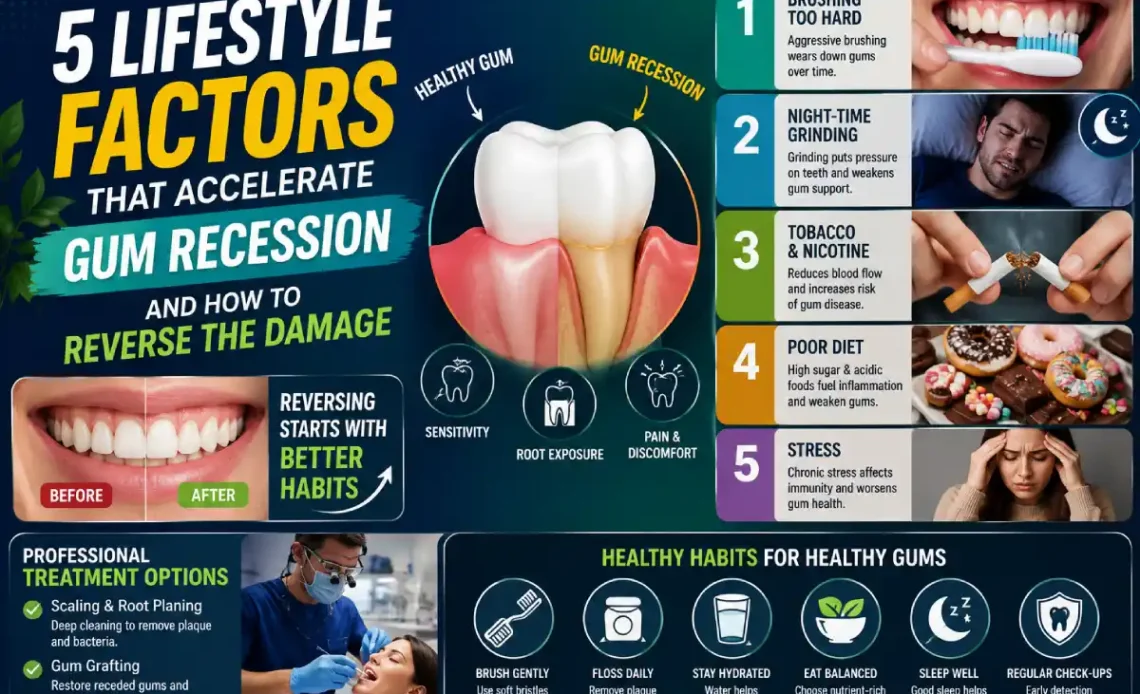
Gum recession is a gradual process and is hardly ever a result of one isolated bad habit. It gradually happens due to the everyday choices you make, such as how intensely you brush your teeth, your eating habits, or if you grind your teeth. Over the years, all of these habits can cause your gumline to recede more and more. The good news is that most of these causes are controllable and if you spot the early signs, you can prevent irreversible damage.
What Gum Recession Actually is (and Why it Doesn’t Grow Back)
Gum recession is a process in which the gum tissue pulls back from the tooth, exposing more of the root surface than it should. The gingival margin, the point at which the healthy gum meets the tooth, is supposed to sit at a fairly consistent height. When that margin retreats, you get the classic signs of recession: teeth that look longer, visible notches near the gumline, and a sharp jolt of dentin hypersensitivity when you drink something cold.
Here’s the kicker: gum tissue doesn’t regenerate by itself. Once it’s gone, it’s gone. You can absolutely stop more loss and manage the symptoms, but reversing recession in any meaningful sense almost always involves surgery. This is an important distinction, because a lot of people read online that you can “heal” receded gums with the right toothpaste or a saltwater rinse. You can’t. What you can do is control these five lifestyle factors below, which are responsible for almost all of the preventable cases out there.
What Professional Treatment Actually Looks Like
When recession is tied to active disease rather than pure mechanical wear, the first step is almost always scaling and root planing. This is a non-surgical deep cleaning that removes tartar and bacterial deposits from below the gumline, smoothing the root surface so gum tissue can reattach more cleanly and inflammation can settle down. Your dentist will usually measure periodontal probing depth first, this tells them how far the disease has progressed and whether it’s still in a stage where deep cleaning alone can arrest it.
For milder cases, that’s often enough to stop things from getting worse. But once recession has progressed past a certain point, no amount of cleaning brings the tissue back. This is where a connective tissue graft comes in – the surgical gold standard for restoring gum coverage over exposed roots. It involves taking a small piece of tissue, usually from the roof of the mouth, and grafting it over the area of recession to rebuild coverage and protect the root from further wear and sensitivity.
Because grafting requires surgical precision and a clear read on how much bone and tissue support remains, this typically isn’t something handled at a routine check-up. Your dentist may refer you to a specialist for a full evaluation, and if you’re in the area, a periodontist melbourne can assess probing depths, tissue quality, and whether grafting or another surgical approach is the right call for your specific case. Getting that referral early, rather than waiting until recession is severe, generally means a simpler procedure and a better long-term result.
Factor One: Brushing Like You’re Scrubbing a Pan
This is the most frequent self-inflicted reason we encounter, and it’s almost always unintentional. Many people believe that more pressure and a firmer brush result in cleaner teeth. In fact, hard bristles together with a vigorous horizontal scrubbing movement physically wear away the gingival margin over time. This is mechanical abrasion, not decay, toothbrush abrasion and recession caused by disease have different appearances, but the final result at the gumline is the same.
The solution is simple and takes about a week to develop as a new habit. Just use a soft-bristled brush. Hold it at a 45-degree angle to the gumline and brush in small circles instead of back-and-forth scrubbing. The bristles should do the work, not your hand. If you notice that your current brush head is spreading and fraying after a month, that’s a sign that you are brushing too hard.
Factor Two: Night-time Grinding You Don’t Even Know About
Bruxism is insidious since many people are unaware of their behavior. It occurs during sleep, as a result of stress, misalignment, or for no apparent reason. The pressure is much greater than that of normal chewing, and the repeated trauma caused does not only erode the enamel, but also increases the resorption of the alveolar bone responsible for supporting the gum tissue.
What’s frustrating about bruxism-induced recession is that the condition can advance in people with perfect brushing habits who regularly attend cleaning sessions. If your partner tells you that you grind your teeth at night or that you wake up with a sore jaw, it’s something to talk to your dentist about. A night guard or splint, which is shaped to your bite, spreads the force across the arch rather than focusing it on a few teeth. This makes a big difference for the gum tissue, and bone loss tends to decrease.
Factor Three: Tobacco and Nicotine Use
Smoking is one of the most obvious, well-documented triggers of gum disease. Nicotine constricts blood vessels, hence reducing blood flow to the gum tissue and slowing down the healing process. This becomes important because the gum tissue is constantly protecting against low-level bacterial irritation, and with a decreased healing ability, minor injuries and inflammation are likely to be exacerbated rather than resolved. Roughly speaking, current smokers are about twice as likely to develop gum disease as non-smokers. The same applies to vaping and smokeless tobacco products as well, although the mechanics vary slightly.
If you are a smoker and notice early signs of recession, quitting is the best decision you can make to slow down the damage. It will not reverse the loss of tissue, but it will change the overall course. Dentists often experience this in real life, when patients stop smoking, their gum tissue usually tends to stabilize in a few months, even without any other treatment.
Factor Four: A Diet That Feeds the Wrong Bacteria
There is a whole ecosystem living in your mouth, the oral microbiome, and what you eat determines which bacteria thrive there. Sugary and acidic fare does a double whammy: sugar feeds the bacteria behind damaging plaque and inflammation, while dietary acidity softens enamel and irritates already-inflamed gum tissue. That makes it more susceptible to physical damage from brushing or grinding.
We are not saying you have to go cold turkey on everything you love, just be mindful about how often and for how long your teeth are exposed to acidic things. It’s worse to sip soda or citrus drinks all day than it is to have a glass in one sitting since you’re keeping your teeth in that acidic state. Other good habits: Rinse with water post-meal, focus on staying hydrated (as a general rule and because saliva naturally buffers acid), and limit snacking.
Factor Five: The Habits Nobody Thinks to Mention
Apart from smoking, grinding, and poor brushing techniques, there are some daily habits and permanent alterations to your mouth that could be playing a significant role in your gum health. Nail-biting, pen-chewing, and oral piercings put pressure on the teeth and gums in very similar ways to bruxism, only over way more waking hours. Wearing a piercing through your lip or tongue essentially makes that part of your mouth into a tiny mortar and pestle, grinding away at those tissues every moment they’re in contact.
None of these habits get flagged in the way smoking or poor brushing does, which is exactly why they’re worth naming directly. If you have an oral piercing and you’re noticing recession specifically around where the jewelry sits, that’s not a coincidence.
Neglect is the Slowest But Most Damaging Factor of all
All of those things above cause direct, mechanical, or physiological damage. But the largest driver of recession globally isn’t any one of those habits, it’s simply ignoring the problem. Forgoing brushing, not flossing, going years without a professional cleaning allows plaque to stay on teeth long enough that it eventually hardens into tartar, or calculus, which you can’t simply brush away no matter how faithfully you brush.
As that tartar starts to build up along and beneath the gumline, it forms a continual source of bacterial irritation that the immune system can’t totally eliminate on its own. That ultimately becomes periodontitis, the advanced form of gum disease that’s behind most cases of irreversible recession, and ultimately tooth loss. This isn’t an uncommon outcome. CDC data shows 47.2% of adults age 30 and older have some form of periodontal disease, and that number climbs to 70.1% in adults 65 and older. Recession is often the visible, physical evidence of that hidden disease taking hold.
Catching it Early: What to Actually Look For
The sooner recession is diagnosed, the more choices you have and the less aggressive the treatment will need to be. There are three warnings you should take seriously: a sensitivity to cold air or cold drinks you didn’t have before, especially in one or two teeth; a visible notch or slight groove at the area where the tooth and gum meet; or teeth that simply look longer than they used to, especially when you compare recent pictures to what you see in the mirror.
None of these signs mean you’re past the point of help. If anything, catching recession at this stage is the best-case scenario, because non-surgical treatment can often halt further loss before it progresses.
Where This Leaves You
You can control gum recession by treating it like a cause-and-effect problem, not something to worry about later. Soften your brushing technique, deal with grinding if it’s present, reduce the acidic and sugary things that cause inflammation, and make sure piercings and nervous habits aren’t chipping away at your gums. If you use tobacco, quit, nothing on this list exacerbates the problem like smoking. And don’t skip the cleanings. You can’t feel tartar until it’s already too late.
Stopping the damage is your daily to-do list. Making up for what’s lost is a discussion to have with your dentist.
Also Read: Understanding Post-Acute Withdrawal Syndrome: Symptoms, Timeline, and Coping Strategies