

Last Updated: July 10, 2026
Seeing your child discover the world is a delight for many. But if you’ve ever asked yourself: ‘If my son can’t see – How do I explain colours to him?’ you are far from the only ones to consider. Many parents of a visually impaired or blind child will question how to approach teaching a concept that’s often associated with sight.
It’s a real relief, then, that colours are not exclusively experienced visually. They are tied up with emotions, social constructs and practical purposes. And children who have no sight at all can understand and appreciate colours based on their own associations and experiences, as well as by analogy and comparison.
Whether you are a parent, guardian, teacher or a family or friend, in this leader we’ll show you how you can introduce the concept of colour to a child who has no or little vision with confidence, assurance & eagerness.
What Does It Mean to Explain Colours to Someone Who Cannot See?
Explaining colours is not about trying to recreate vision. Instead, it involves helping a child understand what colours represent in everyday life.
A blind child may never experience colours visually, but they can still understand that colours:
- Help people describe objects
- Carry symbolic meanings
- Influence emotions
- Are used for communication
- Help organise information
- Form part of everyday conversations
The goal is understanding—not visual imagination.
Why This Question Is So Common Among Parents
Parents naturally want to share every part of the world with their children.
Questions often include:
- Will my child ever understand colours?
- Should I even talk about colours?
- Am I confusing them?
- What if I explain colours incorrectly?
Specialists in visual impairment generally encourage parents to continue talking naturally about colours. Avoiding the topic can actually limit opportunities for learning.
Instead of pretending colours do not exist, help your child understand what they mean to other people and how they are commonly used.
My Son Can’t See. How Do I Explain Colours to Him?
The most effective method is to build colour concepts around experiences your child already understands.
Think about what your child already knows:
- Warm sunshine
- Cool water
- Soft blankets
- Rough tree bark
- Favourite music
- Happy memories
- Exciting celebrations
- Calm bedtime routines
These familiar experiences become bridges for explaining colour.
For example:
Instead of saying:
“Red looks bright.”
Try saying:
“People often connect red with warmth, excitement, fire and love.”
This gives your child meaningful information without relying on vision.
Building Colour Associations
Many teachers of children with visual impairment recommend creating consistent associations.
| Colour | Possible Associations | Everyday Examples |
| Red | Warmth, energy, excitement | Fire, strawberries, Valentine’s Day |
| Blue | Calmness, coolness | Rain, rivers, gentle music |
| Green | Nature, growth | Grass, leaves, forests |
| Yellow | Happiness, sunshine | Warm mornings, laughter |
| Orange | Autumn, creativity | Pumpkins, autumn leaves |
| Purple | Imagination, creativity | Stories, fantasy, royalty |
| Brown | Earth, stability | Soil, wood, chocolate |
| White | Freshness, peace | Snow, clean sheets, clouds |
| Black | Night, quietness | Darkness, sleep, silence |
These are not strict definitions. Different people and cultures associate colours differently, so it is helpful to explain that colour meanings can vary.
Use Real-Life Experiences Instead of Abstract Definitions
Children learn best through everyday life.
For example:
During Cooking
Describe tomatoes as red.
Explain bananas are yellow before they ripen and become brown as they age.
Talk about green herbs and leafy vegetables.
During Nature Walks
Describe grass as green.
Explain that many flowers come in different colours.
Mention that autumn leaves change from green to yellow, orange and red.
During Shopping
Discuss colourful packaging.
Explain traffic lights.
Talk about clothing colours.
These conversations help your child understand how colours are used socially and practically.
Explain Colours Through the Five Senses
Although colour itself cannot be touched, smelled or heard, related experiences can create meaningful connections.
Touch
Associate colours with textures.
For example:
- Green → soft grass
- Brown → rough tree bark
- White → fluffy cotton
Temperature
Children often understand warm and cool sensations.
Examples include:
- Red → warm fireplace
- Blue → cool water
- White → crisp winter air
Sound
Some parents successfully connect music with colour moods.
Examples:
- Bright energetic songs → yellow
- Calm piano music → blue
- Powerful drum beats → red
These associations are personal rather than scientific, but they can make colour concepts more memorable.
Smell
Everyday scents can support learning.
For instance:
- Green → freshly cut grass
- Brown → rich soil
- Orange → citrus fruit
Again, these are associations rather than definitions.
Taste
Favourite foods also help.
Examples include:
- Strawberries → red
- Lemon → yellow
- Mint → green
- Chocolate → brown
The more senses involved, the easier abstract concepts become to understand.
Explain That Colours Help Sighted People Organise the World
One useful lesson is that colours are practical communication tools.
For example, colours help people:
- Match clothes
- Read maps
- Recognise warning signs
- Follow traffic signals
- Decorate homes
- Create artwork
- Express personality
Understanding these purposes helps a blind child appreciate why colours are discussed so often.
A Simple Parent-Friendly Workflow
When introducing a new colour, follow this process:
- Name the colour.
- Mention familiar objects that commonly have that colour.
- Describe associated emotions or experiences.
- Let your child touch the object if possible.
- Reinforce the concept naturally during everyday conversations.
For example:
- “This apple is red.”
- “People often think of red as energetic.”
- “Feel how smooth the apple is.”
- “Red is also the colour used on many stop signs.”
Over time, these repeated experiences help build a rich understanding of colour concepts, even without visual perception.
Set Realistic Expectations
It is important to remember that a child who has never experienced sight may understand colours differently from someone who can see.
That difference is not a failure or a limitation in learning. Instead, it reflects a different way of understanding the world.
Parents should avoid expecting their child to imagine colours visually. Instead, success comes from helping the child understand how colours are used in language, daily life and culture.
A child may confidently know that grass is green, fire engines are often red and the sky is commonly described as blue without ever having a visual image of those colours.
That knowledge is meaningful and valuable in its own right.
Children Born Blind vs Children Who Lost Their Sight
Every child’s experience is unique. The way you explain colours may depend on whether your child has ever experienced vision.
| Experience | How They May Understand Colours | Helpful Approach |
| Blind from birth | Colours are abstract concepts learned through language and experience | Use touch, sound, emotions, temperature and everyday examples |
| Lost sight later in life | May remember colours visually | Connect explanations to their existing visual memories while reinforcing through daily experiences |
Neither approach is better than the other. The goal is to help your child build confidence in understanding the world around them.
Should You Use Colour Words in Everyday Conversation?
Yes. Many parents worry that mentioning colours might confuse a child who cannot see. In reality, avoiding colour words can make everyday conversations more difficult.
Continue using natural language such as:
- “Let’s wear the blue jumper today.”
- “The apples are red.”
- “Your favourite cup is green.”
- “The flowers in the garden are yellow.”
These conversations help your child understand how other people describe objects and environments.
Practical Activities to Help Explain Colours
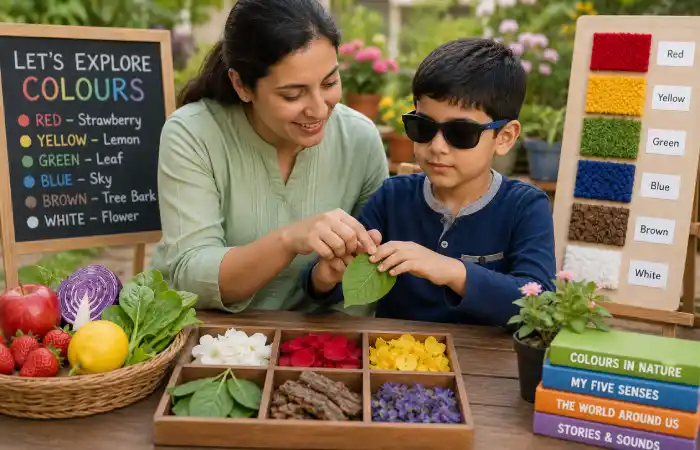
Learning is often more effective when it happens through play and daily routines.
Nature Exploration
Visit a park or garden and let your child touch different plants, flowers and tree bark while describing their common colours.
For example:
- Grass is usually green.
- Roses may be red, white, yellow or pink.
- Autumn leaves often change from green to orange, yellow and red.
Cooking Together
Cooking provides opportunities to discuss colours while involving smell, touch and taste.
Examples include:
- Red tomatoes
- Green spinach
- Yellow lemons
- Brown bread
- White rice
The child experiences the food through multiple senses while learning the associated colour.
Music and Emotion Games
Choose different pieces of music and ask questions such as:
- Which colour might match this cheerful song?
- Which colour could represent a quiet evening?
- Which colour reminds you of excitement?
There are no right or wrong answers. The aim is to encourage creative thinking and personal connections.
Storytelling
Children often learn abstract concepts through stories.
For example:
“The brave knight carried a bright red flag that helped everyone recognise his team.”
The story teaches how colour is used for identification without requiring visual understanding.
Explaining Colours Through Feelings
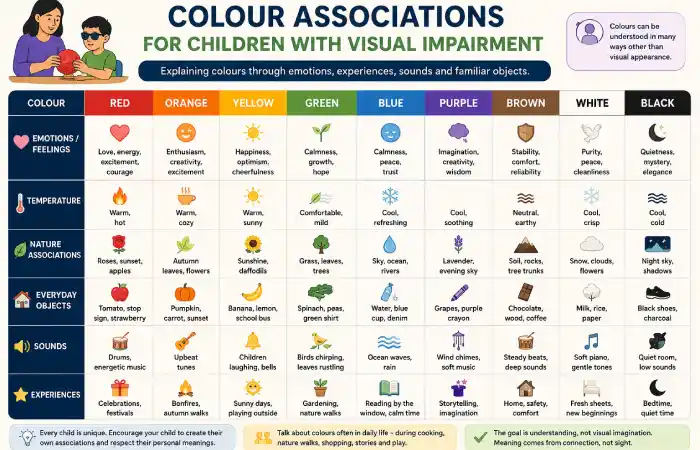
Many colours are commonly linked with emotions. While these associations are not universal, they can help children understand how colours are used in conversation.
| Colour | Common Emotional Association |
| Red | Love, excitement, courage |
| Blue | Calmness, peace, trust |
| Green | Nature, growth, hope |
| Yellow | Happiness, optimism |
| Orange | Energy, enthusiasm |
| Purple | Creativity, imagination |
| White | Cleanliness, peace |
| Black | Mystery, elegance or sadness depending on context |
Explain that these meanings can vary between cultures, traditions and individuals.
Common Mistakes Parents Should Avoid
Trying to Describe What Colors “Look Like”
It is nearly impossible to describe a visual experience accurately to someone who has never seen. Instead of saying:
“Blue looks beautiful.”
Try:
“Many people think blue feels peaceful and reminds them of the sea or the sky.”
Assuming Your Child Cannot Understand Colours
Blind children are capable of understanding abstract ideas when they are explained in meaningful ways.
Correcting Personal Associations
Your child may develop unique connections.
For example:
- Blue reminds them of favourite music.
- Green reminds them of fresh grass.
- Yellow reminds them of laughter.
These personal meanings are perfectly valid.
Avoiding Colour Conversations
Ignoring colours completely can leave children feeling excluded from everyday discussions.
Natural, regular conversations build understanding over time.
Expectations Management
Parents often hope their child will eventually “picture” colours mentally.
For children who have never had vision, this may not happen—and that is completely normal.
Instead, realistic expectations include helping your child:
- Understand how colours are used.
- Recognise colour-related language.
- Participate confidently in conversations.
- Understand symbols such as traffic lights or warning labels.
- Build their own meaningful associations.
Success should be measured by understanding, not visual imagination.
FAQ’s
My son can’t see. How do I explain colours to him?
Focus on experiences he already understands, such as warmth, textures, sounds, emotions and familiar objects. Explain how sighted people commonly associate colours with these experiences instead of trying to describe how colours look.
Can blind children understand colours?
Yes even though the colour of light isn’t something they are able to see; colour itself can be interpreted for what it signifies and also for the ways it is commonly applied to things and why it’s significant to human expression.
Should I stop talking about colours?
No. Continue using colour words naturally in conversation. This helps your child learn how people describe objects and environments.
Is there one correct way to explain colours?
No. Every child learns differently. Some respond well to emotions, others to music, textures, stories or practical examples. Try different approaches and discover what works best for your child.
Can teachers help reinforce colour concepts?
Yes. Teachers working with visually impaired children usually use tactile objects, real life objects, language descriptions and other senses in the teaching of colours.
Conclusion
And as for “My son can’t see. How do I explain colours to him?” there is no right or wrong way – and there’s certainly no right script.
All that you can do is to help him make some kind of connections in life to something that he already knows and likes.
There is no point in trying to explain a new sense, so connect what you have got already – language, feeling, touch, smell, sound and, as mentioned before, the everyday – and, hopefully, your child will begin to have a little grasp on what you mean in terms of a useful communicative tool – perhaps in storytelling or in relationships with people. All that I ask for is that you are patient; abstract concepts take time to take up for all of our children, but with all of our encouragement they will soon grasp what all of this is really about in their own way of the world.